Evolving MelodyArc’s website as the product story changed
Three generations of positioning, information architecture, visual storytelling, motion, and Framer implementation for an evolving B2B service platform.
- Role
- UX Design Lead
- Duration
- July 2023–present
- Team
- Cross-functional
- Scope
- Strategy, visual design, motion & Framer
Challenge
MelodyArc’s public story changed as the company’s product and positioning developed. Each website needed to make a technically complex B2B service understandable without flattening the role of data, AI, rules, and people.
The work was not a single reskin. Each generation required a renewed hierarchy, narrative, visual language, and Framer implementation that could carry the next version of the company’s story.
Evidence
Three shipped websites provide a visible record of that evolution. The archived Framer builds remain available alongside the current site.
Decisions
- Reframe before restyling. Each iteration begins with what the company needs its audience to understand, then aligns page order, language, and visuals around that job.
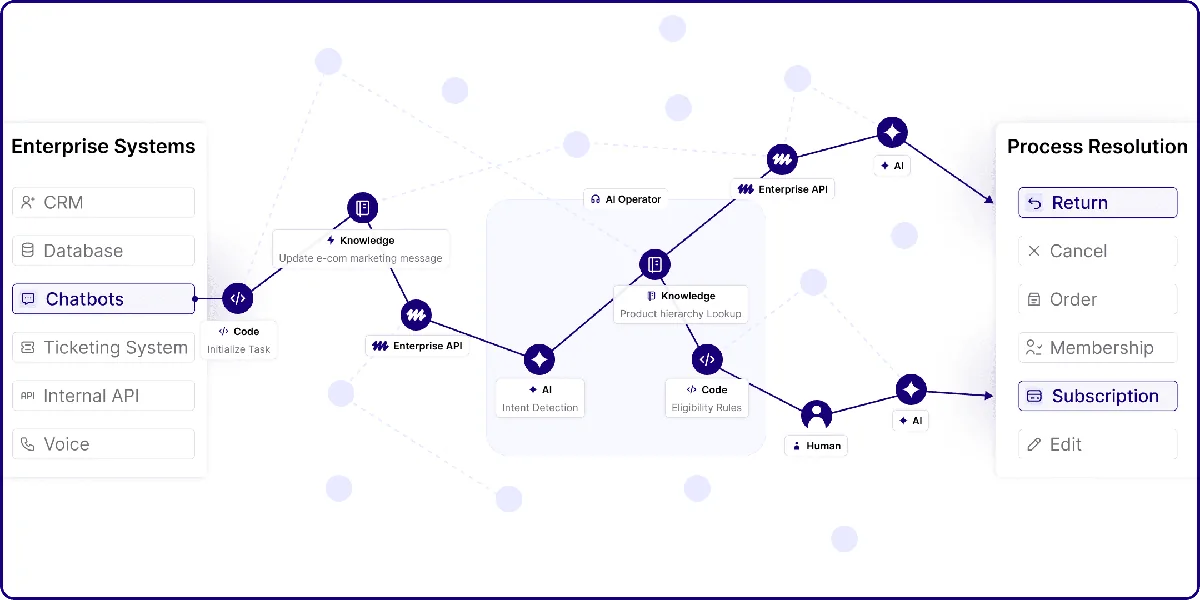
- Show systems, not generic AI imagery. Workflow diagrams, interface fragments, and connected nodes make the service model more concrete.
- Build a reusable visual grammar. Indigo linework, interface modules, restrained depth, and motion recur across sections so new ideas still feel related.
- Design and build in the same loop. Implementing the sites in Framer made responsive behavior, motion, and editorial pacing part of the design process.
Version one: support operations
The first site positioned MelodyArc around support operations on one AI-powered platform. Its job was to introduce the service model and connect operational pain points with a unified workflow.

Version two: AI operators
The second site expanded the narrative around AI operators. A lighter system and more modular storytelling made room for multiple roles, capabilities, and product ideas without turning the page into a feature catalogue.

Current site: one system, three layers
The current site organizes the product story through Orchestrate → Execute → Record. Each layer uses the same node language, linework, interface fragments, and restrained depth so the visuals can carry technical meaning without becoming a generic AI metaphor.


Outcome
The work delivered three distinct Framer websites and a more coherent public language for MelodyArc as its positioning evolved. This case study reports shipped design scope; conversion or business-impact metrics are intentionally not inferred.
Reflection
Working across strategy, visual design, motion, and implementation made each website a useful test of product clarity. When an idea was hard to explain publicly, it often exposed language or hierarchy that also needed attention inside the product.